
Wave-Particle Interactions
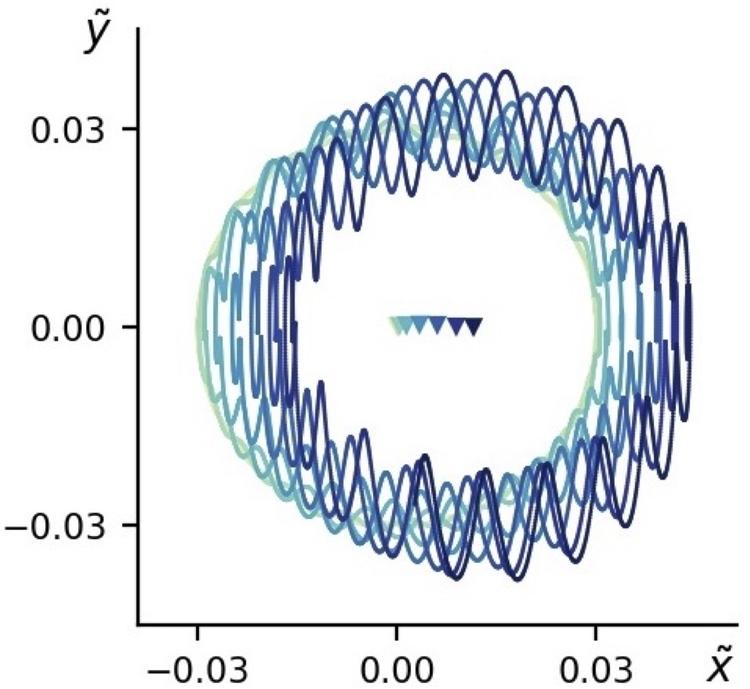
When waves in plasma interact with charged particles, energy and momentum can be exchanged. Generally, the wave-particle interaction looks very different depending on whether the particle is resonant with the wave, and the two types of interaction are often treated with very different mathematics. Nevertheless, the total interaction must conserve energy and momentum as they are redistributed between electromagnetic fields, resonant particles, and nonresonant particles. Understanding of these processes is critical to understanding wave-based rotation drive, a valuable form of plasma control.
The Interplay of Radiation and Collisions
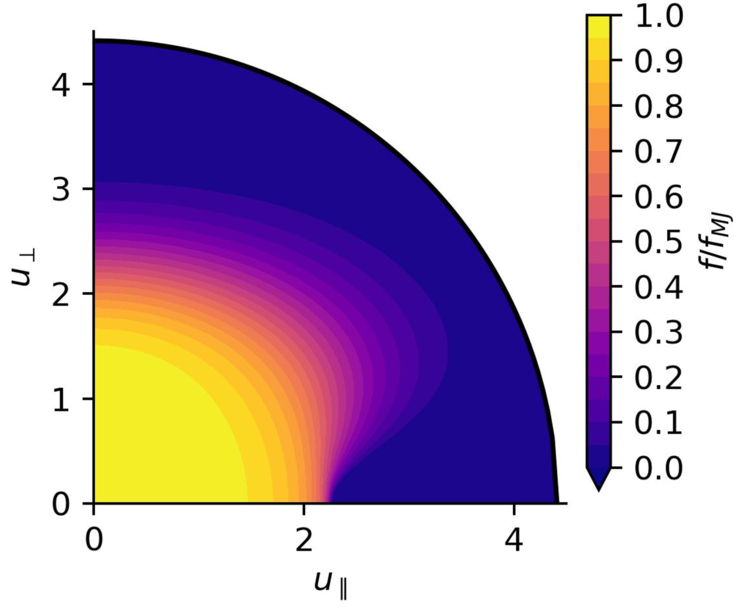
Electrons in a magnetic field emit electromagnetic waves in the form of cyclotron or synchrotron radiation. Depending on the plasma scale, these waves can escape the plasma or be reabsorbed by other electrons. This creates an advection-diffusion process in the electron phase space, which competes with the advection-diffusion process from collisions to create a radiative-collisional kinetic equilibrium. Finding such equilibria is important to determining the self-consistent radiative losses of aneutronic proton-Boron 11 fusion reactors, as well as the stability properties of relativistic laboratory and astrophysical plasmas.
Power Flow in Proton-Boron Fusion
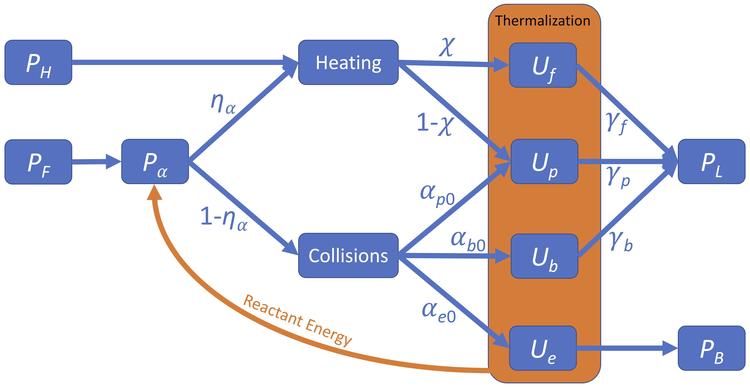
Proton-Boron 11 (pB11) fusion is appealing because it does not require rare and radioactive fuels, nor does it produce fast neutrons, in contrast with more mainstream fuels such as deuterium-tritium (DT). However, it is much more difficult to harness, with a lower cross section that occurs at a much higher temperature, making net power production much more difficult to achieve. In the natural thermonuclear power balance, fusion energy is transferred to helium, which then collides with proton, boron, and electrons, before leaving the plasma due to particle losses and bremsstrahlung radiation. Altering this power balance, using waves and plasma reshaping, can signficantly reduce the requirements on pB11 fusion reactors, making them much more economically viable.